The mechanistic worldview described in the previous chapter has dominated Western thought for centuries, shaping not just scientific research but cultural narratives, ethical frameworks, and our most intimate sense of what we are. It treats consciousness as derivative from matter—a recent accident, a byproduct of sufficient neural complexity, essentially an illusion generated by blind processes.
This framework claims solid ground: the spectacular success of physics, the technological mastery it enables, the institutional authority of science itself. But that claim confuses physics—the measurement and prediction of physical phenomena—with physicalism, the metaphysical assertion that only the physical exists.
That ground is less solid than it appears. All worldviews, including physicalism, rest on unexplained primitives that simply must be accepted. Once we recognize this, alternatives become visible that make better sense of consciousness, meaning, and our obligations to other beings.
Stories We Tell About Reality
We need to be clear, however, about what we’re comparing. This is not science versus anti-science, or evidence versus speculation. It’s competing metaphysical frameworks—different stories about what exists and why. But crucially, these frameworks don’t just interpret the same evidence differently; they disagree about what counts as evidence in the first place.
Physics has been spectacularly successful at measuring and predicting physical phenomena. Its precision is extraordinary, its applications transformative. No serious person disputes this. But physics—the actual science of measurement and prediction—is not the same as physicalism, the metaphysical claim that only physical things are fundamentally real, that consciousness is derivative, that subjective experience is secondary or illusory.
Physicalism treats subjective experience as something to be reduced to physical interactions—“nothing but” neural firing—rather than accepted as a fundamental aspect of reality. When you experience the redness of red, the grief of loss, the recognition of consciousness in another being, the physicalist framework says that their explanation must ultimately be in terms of physics and chemistry.
But “fundamental” doesn’t mean “inexplicable” or “mysterious.” Physics treats charge and mass as fundamental—not reducible to something more basic—yet still explains how they behave, why they take specific values, how they manifest in different contexts. Similarly, treating consciousness-related phenomena as fundamental means they can’t be reduced to or fully explained by physical processes alone, but we can still explain particular conscious experiences—why Tahlequah grieves (she lost her child), why certain brain organizations support certain experiences, how consciousness manifests differently through different evolutionary paths. These explanations operate at appropriate levels—psychological, phenomenological, organizational—without requiring reduction to particle physics.
We can interpret the same observations through different frameworks—neural correlates can be seen as consciousness being produced by brain activity or as complementary aspects manifesting together; Tahlequah’s behavior can be seen as complex instinct or genuine grief. Like quantum mechanics where an electron exhibits either particle properties or wave properties depending on which we look for, the framework shapes what we see.
But more fundamentally, these frameworks disagree about what counts as evidence in the first place. Physicalism says: “Show me third-person measurements or it’s not real evidence.” Continuum frameworks say: “First-person experience is evidence about consciousness; dismissing it because it can’t be measured is circular—it assumes what needs to be proven.”
Consider Tahlequah’s seventeen-day vigil. The physical behaviors—carrying her dead calf, diving to retrieve it, her exhaustion—are not in dispute. Physicalism says we cannot know whether this indicates genuine grief because we cannot measure subjective experience in orcas; to claim it’s grief is anthropomorphism. A continuum framework says that such sustained, costly behavior in the face of exhaustion is precisely the kind of evidence that indicates subjective experience—the same evidence we use to infer consciousness and grief in humans.
Neither framework can be proven by appealing to the premises of the other. Physicalism cannot prove subjective experience is derivative by measuring only physical properties—that’s circular reasoning. A continuum framework cannot prove consciousness arises from a psychophysical ground using only physicalist tools designed to measure the physical and ignore the subjective.
But we can evaluate these frameworks by what they make visible and invisible, what they explain naturally versus what they struggle to accommodate, and what consequences they generate for how we live. The crucial question is whether physicalism itself rests on empirical discovery or philosophical commitment. The answer comes from an unexpected source.
“The A Priori Commitment”
One of the most distinguished evolutionary biologists of the 20th century made a remarkably candid admission about the foundation of materialist explanations. Richard Lewontin, writing in the New York Review of Books, acknowledged: Richard C. Lewontin, “Billions and Billions of Demons,” The New York Review of Books, January 9, 1997 (review of Carl Sagan’s The Demon-Haunted World)
“It is not that the methods and institutions of science somehow compel us to accept a material explanation of the phenomenal world, but, on the contrary, that we are forced by our a priori adherence to material causes to create an apparatus of investigation and a set of concepts that produce material explanations, no matter how counter-intuitive, no matter how mystifying to the uninitiated. Moreover, that materialism is absolute, for we cannot allow a Divine Foot in the door.”
This is an extraordinary admission. Lewontin acknowledges that materialism is not a conclusion derived from scientific investigation but a commitment established prior to investigation. The “apparatus” and “concepts” of science are designed to produce material explanations because researchers have decided in advance that only material explanations are acceptable—“no matter how counter-intuitive, no matter how mystifying.”
Lewontin is outright admitting what critics have consistently claimed about the modern scientific worldview: the metaphysics aren’t determined by the evidence; the metaphysics determine the methods. Scientists haven’t discovered through empirical investigation that only matter exists. They’ve decided a priori that only material causes count, then created investigative methods that by design can only detect material causes. The conclusion is determined by the assumptions.
The final phrase reveals the ideological nature of this commitment: “we cannot allow a Divine Foot in the door.” This is not empirical caution but philosophical absolutism. It’s a declaration that certain possibilities are excluded before investigation even begins.
This matters because the framework developed in this book is not trying to get a “Divine Foot in the door.” We’re not arguing for supernatural intervention or religious dogma. We’re recognizing that when physics leaves intrinsic nature unspecified, when consciousness resists reduction to mechanism, when beings like cetaceans manifest sophisticated interiority through utterly alien architecture—materialism’s a priori commitment prevents honest investigation of what this might mean.
Lewontin’s candor reveals what’s at stake: not science versus religion, but whether we can investigate reality without ideological blinders that exclude possibilities before we look.
If physicalism rests on a priori commitment rather than empirical discovery, it has no special epistemic status. It’s one metaphysical choice among others—no more ‘proven’ by evidence than the alternatives it dismisses. All frameworks must begin somewhere, with primitives they cannot explain. The question is not which can prove itself, but which primitives we accept and what follows from that choice.
What All Frameworks Rest On
Every explanation has to stop somewhere. When physicists tell us that electrons have charge, or that the speed of light is constant, or that quantum fields exist, we can ask: Why? Why do electrons have the charge they do rather than some other value? Why does the universe obey these particular laws rather than different ones?
The honest answer is: we don’t know. More importantly, many physicists argue we may never know—because some facts about reality simply don’t have deeper explanations. They’re what philosophers call “brute facts” or “irreducible properties”: features of the universe that are fundamental, that bottom out, that just are.
This idea isn’t controversial in physics. As philosopher Eliot Sober notes in his review of Thomas Nagel’s work, “Scientists already leave room for brute facts… When they say that a law is ‘fundamental,’ they mean that it can’t be explained by anything deeper.“ Elliott Sober’s review of Mind & Cosmos: “Remarkable Facts: On Thomas Nagel’s radical claim that science should go teleological” Boston 50 Review, Nov 7, 2012 Physicist Sean Carroll puts it even more directly: “At the deepest level, the laws of physics might just be brute facts. Asking for something deeper could simply be a confusion.“ Sean Carroll, The Big Picture, p. 355
This admission is critical. It means physicalism’s apparent explanatory advantage—that it rests on nothing but basic physics—dissolves. The mechanistic worldview is not a complete account of reality but a map with significant blank spaces.
And it’s not just the laws—the regularities and patterns—that bottom out. The properties of matter itself are irreducible. We can describe what charge, mass, and spin do, measure their effects with extraordinary precision, predict how they’ll behave under different conditions. But we cannot explain what they intrinsically are or why they have the values they do. For example, the fine-structure constant, alpha ($\alpha$) determines the strength of electromagnetism. But $\alpha$ is not predicted by the Standard Model, and it cannot be derived, only measured. Its value is approximately $\alpha \approx \frac{1}{137}$. Moreover, $\alpha$ is dimensionless. Why? No deeper explanation exists. It simply is. Arthur I. Miller, 137: Jung, Pauli, and the Pursuit of a Scientific Obsession (New York: W. W. Norton & Company, 2009), xx–xx
But notice there is a crucial assumption embedded here, one so deeply held it’s rarely articulated. When physicists speak of fundamental properties and laws as “brute facts,” they implicitly assume these irreducible physical features are the only fundamental features of the universe. Mass, electrical charge, quantum fields are assumed to exhaustively account for all that exists.
What if that assumption is false, what if the contents of the universe include non-physical aspects that are no less real than mass or charge but that cannot be measured, even in principle?
This possibility was recognized nearly a century ago by one of the most distinguished philosophers of the 20th century. Bertrand Russell, in his 1927 work The Analysis of Matter, pointed out something remarkable: physics actually tells us nothing about the intrinsic nature of matter. Bertrand Russell, The Analysis of Matter (London: Kegan Paul, Trench, Trubner & Co., 1927), xx–xx Physics describes only structure—how things relate and behave, what patterns they form, what correlations obtain. It gives us the mathematical skeleton of reality but remains silent about what “flesh” hangs on those bones.
This is the blind spot that opens conceptual space for alternatives. If physics remains silent about intrinsic nature, then assuming matter is ‘purely physical’ is a metaphysical choice, not an empirical discovery.
As Russell put it, physics deals with “the causal skeleton of the world.” We know how elementary particles interact, what forces govern their motion, what conservation laws constrain their behavior. But we don’t know what they are in themselves. The equations tell us about mass, charge, and spin as relational properties—how particles respond to fields, how they influence other particles—but the intrinsic nature that grounds these relations remains unspecified. Physics gives us the “what happens” but not the “what is.”
Russell’s insight opens a crucial possibility: if the intrinsic nature of physical reality is left unspecified by physics, then perhaps that intrinsic nature isn’t purely physical in the sense we’ve assumed. Perhaps experiential properties—what philosophers call phenomenal or qualitative properties, what it’s like to be something—aren’t foreign to matter but rather constitute part of its fundamental nature.
This isn’t mysticism or wishful thinking. It’s recognizing that when we talk about “purely physical” properties as brute facts, we’re making an assumption that goes beyond what physics itself establishes. Physics is silent about intrinsic nature. The question of what grounds the mathematical structure—what “realizes” the patterns we measure—is a metaphysical question, not an empirical one.
Once we see this clearly—that physics rests on irreducible features whose intrinsic nature is unspecified, and that the assumption of their “purely physical” character is itself a metaphysical commitment rather than an empirical discovery—the landscape transforms. The supposed advantage of the mechanistic worldview dissolves. We’re not comparing “explanatory physics” with “mysterious consciousness.” We’re comparing different metaphysical frameworks, each of which must posit certain features as fundamental.
The question becomes: Given that all frameworks rest on unexplained primitives, which choice of primitives makes the most sense of everything we know—including the undeniable reality of consciousness itself?
Three Frameworks
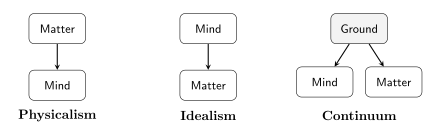
Recognizing that all worldviews bottom out in brute facts, we can identify three coherent metaphysical positions. Each makes different choices about what to treat as fundamental. Each has strengths and weaknesses. None can claim epistemic superiority through “deeper explanation” because all explanation must stop somewhere.
Physicalism holds that matter is fundamental and consciousness derivative. Physical properties—mass, charge, fields, spacetime structure—are the basic ingredients of reality. Consciousness somehow emerges from sufficiently complex physical organization, particularly neural activity in brains. Subjective experience is either reducible to and identical with brain processes, or supervenes on them in ways that preserve physical causal closure. Supervenience differs from identity in that mental states are not claimed to be identical with brain states, only dependent on them: no mental difference without a physical difference, even if the mental cannot be reduced to or identified with the physical.
The appeal of this framework is substantial. It appears parsimonious, requiring only one kind of fundamental stuff: matter and the forces that affect it. It avoids the interaction problem that plagued Cartesian dualism—how could an immaterial mind causally affect material brain? It’s consistent with the spectacular success of physics and neuroscience. And it coheres with the dominant scientific worldview that has proven so powerful in technological applications.
But physicalism faces a persistent challenge: consciousness resists the kind of explanation that works elsewhere. We can explain temperature as mean molecular kinetic energy, genes as DNA sequences, solidity as electromagnetic forces between atoms. In each case, we reduce one phenomenon to more fundamental physical processes. Yet when we try to explain consciousness this way—to show how and why physical processes should feel like something from the inside—we hit what philosopher David Chalmers called “the hard problem:” no matter how completely we map neural correlates of consciousness, how thoroughly we understand information processing in brains, a gap remains between third-person physical description and first-person subjective experience.
Idealism takes the opposite approach: mind is fundamental, and matter is derivative. Mental properties—experience, awareness, intentionality—are the basic features of reality. The physical world is constituted by mental processes, whether divine consciousness (Berkeley), absolute spirit (Hegel), or universal mind (various forms of panpsychism or cosmopsychism).
This framework has the advantage of taking consciousness seriously as a genuine feature of reality rather than an anomaly to be explained away. It faces no hard problem because experience is fundamental, not derivative. But idealism faces the challenge of accounting for the stubborn stability of the physical world. Why does matter behave according to mathematical laws if it’s fundamentally mental? Why can’t we alter physical reality through thought alone?
Continuum frameworks offer a third way: neither mind nor matter is fundamental. Both are aspects of what some refer to as a psychophysical continuum—an undivided ground that is intrinsically neither mental nor physical but differentiates into both. In such a continuum, physical properties manifest as exterior aspects—relational, structural, or measurable—while mental properties manifest as its interior aspect—experiential, qualitative, or felt. Mental and physical features are derivatives of an underlying, unified whole.
A crucial precision: In continuum frameworks, it’s the psychophysical ground that is fundamental, not consciousness itself. Consciousness as we experience it arises from the differentiation and organization of this ground into complementary aspects. This is why ‘fundamental’ here means what physics means: irreducible to something more basic, but still manifesting in different ways depending on organizational structure. The ground doesn’t ‘produce’ consciousness any more than it ‘produces’ physical structure—both aspects differentiate together from what is intrinsically neither.
Remarkably, slightly different versions of this approach emerged independently from physicists grappling with quantum mechanics. Wolfgang Pauli, one of the founders of quantum theory, worked with psychologist Carl Jung to address the “psychophysical problem”—the enduring puzzle of how mind and matter relate. Their collaboration focused on developing a conceptual framework, rooted in the ancient idea of the unus mundus (unified world), that could account for both physical and psychological phenomena. Central to this was what they termed synchronicity—acausal connecting principles where meaningful coincidences between internal psychological states and external physical events point to an underlying undivided ground from which both mental and physical emerge.
David Bohm, developing his alternative interpretation of quantum mechanics, arrived at similar conclusions about what he called the “implicate order”—a holistic ground from which both mental and physical features unfold. That distinguished physicists found such frameworks necessary for understanding quantum phenomena lends continuum frameworks intellectual credibility beyond mere philosophical speculation.
Thinkers across history and traditions have proposed similar conceptions. Recent philosophical versions include decompositional neutral monism (following Pauli and Jung), certain interpretations of Buddhist and Advaita Vedanta philosophy, and Russell’s neutral monism. While differing in specifics, these frameworks share core predictions: consciousness should manifest widely, vary along spectrums of integration and complexity, and appear wherever organization supports sufficient experiential articulation.
The arguments here draw on this continuum framework. When we speak of consciousness manifesting through complex brains, we mean this differentiation—experiential interiority arising alongside sophisticated physical organization. When we explore consciousness in different species, particularly cetaceans, we’re acknowledging that complex cognition can evolve through radically different lineages under vastly different circumstances. We cannot know what it is like to be a dolphin, but we also cannot credibly presume that its sense of interiority is any less than ours.
This recognition doesn’t undermine physics or devalue its achievements. The mathematical structure physics describes is real and incredibly powerful. But structure requires something to be structured. Relations require relata. And the nature of those fundamental relata is precisely what’s at stake when we ask about the place of consciousness in nature.
Why This Framework Warrants Consideration
Given that all frameworks rest on unexplained primitives, what recommends continuum approaches for serious consideration?
It handles the evidence naturally. The intimate correlation between brain states and conscious experiences, which physicalism treats as mysterious causation requiring explanation, becomes straightforward: they’re two aspects of the same psychophysical reality viewed from different perspectives. The degrees and varieties of consciousness across species, which physicalism struggles to explain (when does matter become conscious? how much brain complexity is needed?), become natural variation along the continuum.
Cetacean brains aren’t puzzling because they’re “too large” or “differently organized”—they’re sophisticated manifestations along the psychophysical continuum. For fifteen million years, sperm whales have sustained brains weighing nine kilograms—six times human brain mass. This temporal depth suggests not evolutionary accident but sustained, stable manifestation—forms of experiential interiority explored and refined far longer than our own lineage has existed.
It avoids the standard problems. The interaction problem that fatally undermined Cartesian dualism doesn’t arise because there aren’t two separate substances requiring a bridge. The emergence problem that haunts physicalism—how does subjective experience arise from non-experiential matter?—doesn’t arise because experiential properties are aspects of the fundamental reality, not generated from their opposite. The combination problem that plagues bottom-up approaches doesn’t arise because consciousness isn’t built from proto-conscious parts but differentiates from a unified whole.
It’s supported by convergent thinking. Thomas Nagel argued extensively in Mind and Cosmos that reductive approaches to consciousness systematically fail—not because we lack detailed knowledge, but because the explanatory strategy itself is inadequate. The persistent explanatory gap isn’t a temporary problem awaiting better neuroscience. It’s telling us something about the nature of things. David Chalmers’ “hard problem” makes the same point from a different angle. After mapping every neural correlate, tracking every information-processing pathway, explaining every behavioral output—a residual question remains: Why should any of this feel like something from the inside?
Continuum frameworks make the question dissolve: physical organization and experiential quality aren’t related as cause and effect but as exterior and interior aspects of a unified reality. Rather than trying to reduce mental to physical (which systematically fails), or physical to mental (which leaves material regularity mysterious), we can investigate how different organizations manifest different expressions of the continuum.
This doesn’t eliminate hard scientific work or replace neuroscience with philosophy. Understanding exactly how brain organization relates to conscious experience remains an enormous empirical challenge. But it changes the framework within which we approach that challenge. We’re not trying to show how matter magically produces something completely unlike itself. We’re investigating how a fundamentally psychophysical reality differentiates into aspects through physical organization.
From Metaphysics to Pragmatics
We’ve now seen that three coherent metaphysical frameworks exist—physicalism, idealism, and continuum approaches—and that all three rest on the same foundation: unexplained primitives. None can claim epistemic superiority through “deeper explanation” because all explanation stops somewhere.
Continuum frameworks have distinct features recommending them for consideration: they handle the evidence more naturally, avoid the problems plaguing other frameworks, and gain support from convergent developments across domains. The fact that serious physicists like Pauli and Bohm found such frameworks necessary for understanding quantum mechanics suggests they’re not arbitrary speculation but a reflection of something real about nature’s organization.
But we cannot prove continuum frameworks are metaphysically true any more than physicalism can prove its fundamental assumptions. These are frameworks for interpreting reality, not empirical discoveries. They’re choices about which primitives to accept, which aspects of experience to privilege, which explanatory strategies to pursue. And when we can’t establish metaphysical truth with certainty, the question transforms.
The question becomes: What follows from living as if each framework were true? What does each worldview generate in terms of meaning, ethics, value, and action? What kind of world does each create when taken seriously, when allowed to shape not just intellectual positions but lived choices?
This shift from metaphysical argument to pragmatic assessment isn’t relativism. Not all frameworks are equally good. We can evaluate worldviews by their consequences—psychological, ethical, existential, practical. We can ask: Does this framework make sense of experience? Does it support flourishing? Does it lead toward wisdom or confusion? Does it generate sustainable ways of being?
The modern scientific worldview, taken to its logical conclusions, suggests that consciousness is an accidental byproduct of neural complexity, that meaning is illusion, that purpose is mere projection, that values are subjective preferences without objective grounding. This framework has given us tremendous technological power while contributing to what many recognize as a meaning crisis—the ability to manipulate matter combined with an inability to say why anything ultimately matters.
If we view reality through a continuum lens, the implications are immediate and profound. Encountering another conscious being isn’t meeting ‘a biological machine that happens to feel’ but recognizing another manifestation of the same fundamental reality from which our own consciousness arises. This isn’t sentiment—it’s ontology.
This grants ontological dignity not as comforting fiction or moral sentiment but as recognition of what’s actually there. In continuum frameworks, all conscious beings—humans, cetaceans, other animals—are different manifestations of the psychophysical continuum, different ways the holistic ground differentiates into experiential and physical aspects. The difference between humans and cetaceans isn’t that we “have” consciousness while their status remains uncertain. It’s that we represent different evolutionary explorations of how complex physical organization can manifest rich experiential interiority.
The stakes are high. If consciousness arises from reality’s fundamental nature, if other species might be our cognitive peers manifesting different regions of the psychophysical continuum, then we may be committing one of the great moral catastrophes of history while prevented from seeing it clearly by the very framework we’ve inherited for making sense of the world.
This isn’t an academic issue. Cetacean species face existential threats from changes we’ve made to their world. They possess brains that have been large and metabolically expensive for millions of years—far longer than our own lineage. Their behaviors suggest sophisticated social intelligence, cultural transmission, self-awareness. Yet the dominant framework tells us these are “just” biological machines, that their behaviors might be “mere” reflexes however complex, that consciousness requires the specific type of cognition humans possess.
What if that framework is wrong? What if we’re destroying beings who manifest experiential depth comparable to our own, whose massive brains express rich interiority along a different branch of the psychophysical continuum? Continuum frameworks make this possibility—cosmic equivalence—vivid and urgent in a way that physicalism cannot.
If experiential interiority arises from a psychophysical ground that is fundamental to reality—manifesting wherever evolution creates sufficient organizational complexity—then we should expect it wherever evolution explores complex organization. We should expect it to take forms radically different from our own, manifesting through different physical configurations, expressing different regions of the continuum. And we do find it: in beings whose brains evolved through entirely independent pathways, whose intelligence operates by different principles, whose experiential richness we can barely imagine but have no grounds for dismissing.
This is where our inquiry leads: not to metaphysical certainty, but to recognition that we face a choice—and that choosing has consequences we can evaluate, test, and live by. In the next chapter, we turn to examine the limits of language itself in capturing these ideas, before moving to the evidence that tests which framework better accommodates what we actually find across evolution.